
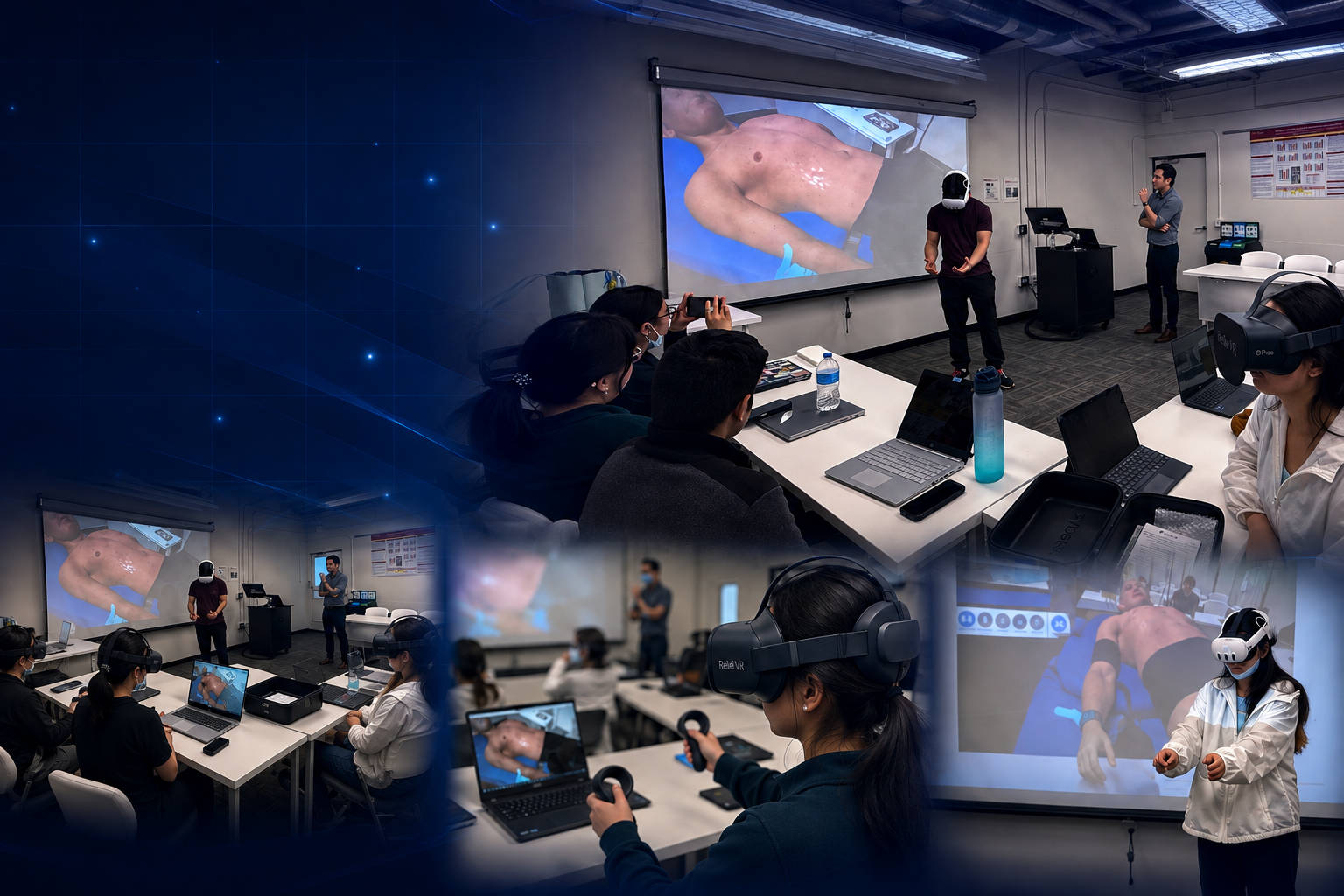
Buildup Student Competency by Immersive Simulation
Give your students a competitive edge through immersive, competency-based XR simulation. Strengthen clinical skills and confidence, elevate your institution's reputation for innovation, and reduce the recurring costs associated with standardized patients and promote more consistent, standardized evaluation by reducing variability in faculty-based scoring.
What this engagement covers
Virtual reality
Fully immersive encounters for high-consequence, low-frequency scenarios that are difficult to stage physically.
Extended reality
Blended physical and digital environments layered onto existing skills labs and simulation suites.
Virtual patients
Conversational, branching patients with clinical variability, comorbidity, and authentic communication demands.
Standardized patients
Hybrid models combining trained human actors with digital instrumentation and consistent rubric capture.
AI-powered OSCE
Structured examinations with AI-assisted scoring support, rubric calibration, and rapid feedback generation.
Clinical reasoning
Scenarios instrumented to reveal reasoning process, not just the final recommendation.
Emergency medicine simulations
Time-pressured, team-based scenarios covering anaphylaxis, overdose, cardiac arrest, and acute deterioration.
Patient counseling & communication
Repeatable practice with empathy, health literacy, motivational interviewing, and difficult conversations.
Faculty dashboards & analytics
Cohort, course, and competency views with drill-down to individual attempts, rubric items, and trend lines.
What competency looks like when it is measured continuously
An illustrative cohort view: competency attainment across domains, with drill-down to individual attempts and rubric items.
Cohort competency attainment
Student analytics
Per-student attempt history, rubric-item performance, feedback threads, and remediation triggers.
Competency tracking
Longitudinal attainment across the professional sequence rather than isolated course grades.
Performance reporting
Committee-ready and accreditation-ready exports generated from live data.
What you receive
- Simulation strategy aligned to curricular competencies
- Scenario library specification and authoring standards
- AI-powered OSCE blueprint with validated rubrics
- Faculty rater training and calibration protocol
- Analytics and dashboard requirements definition
- Vendor-neutral technology evaluation matrix
- Competency tracking and performance reporting model
- Pilot design with evaluation plan
How the work sequences
- Weeks 1–4
Simulation audit
Review of existing facilities, scenarios, rubrics, and assessment data quality.
- Weeks 5–10
Blueprint & design
Competency mapping, scenario specification, rubric engineering, and analytics requirements.
- Weeks 11–18
Pilot
Instrumented pilot cohort with rater calibration and student experience evaluation.
- Months 5–12
Scale & report
Program-wide rollout, dashboard deployment, and longitudinal competency reporting.
What changes for your institution
Objectivity
Calibrated rubrics and reduced inter-rater variance.
Scale
More encounters per student without proportional faculty burden.
Insight
Competency data that identifies curricular weakness early.
Readiness
Graduates rehearsed in scenarios they will actually face.
Turn simulation into your strongest source of outcome evidence
We work with the facilities and vendors you already have before recommending anything new.